Wall Street hits six-month low as Trump ‘appears to lose his grip on markets’
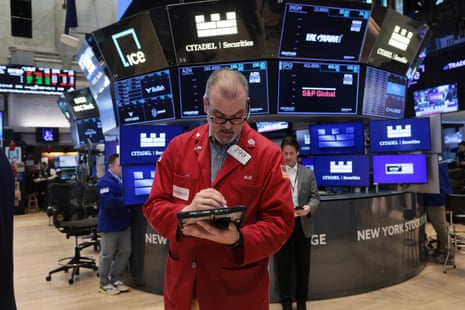
The US stock market has dropped to its lowest level since last September, as analysts warn that president Trump may be losing his grip on the markets.
The S&P 500 index has dropped by 0.8% today to 6,425 points, adding to Thursday's 1.75% fall on the benchmark US stock market index.
The tech-focused Nasdaq index is down 1%, also at a six-month low.
Stocks are falling despite Trump's decision, after markets closed yesterday, to pause any attack on Iranian energy plants for a further 10 days.
That extension has been seen as the latest example of a Taco moment (Trump always chickens out) – a term created almost a year ago when the president u-turned on his Liberation Day trade war.
But with oil rising today (Brent crude is up 2.75% at $111 a barrel), the effect of the Taco appears to be waning.
Fawad Razaqzada, market analyst at Forex.com, says:
double quotation mark Trump appears to be losing his grip on the markets. Investors no longer seem to take his statements at face value—if anything, they're beginning to trade against them, waiting for tangible proof before reacting. That's an uncomfortable position for any policymaker to be in. It doesn't help that Israel reported new air strikes on Tehran and Isfahan, while Iran announced a fresh wave of missile strikes against Israel.But going back to the point of TACO becoming ineffective, oil prices fell by roughly $4.50 a barrel yesterday following Trump's latest post about extending the pause on planned strikes against Iran's energy infrastructure. But the move was notably more muted than Monday's sharp sell-off in oil and rally in equities, and it was unwound far more quickly. The oil market, in particular, seems to be growing increasingly desensitised to the rhetoric.
My colleague Eduardo Porter has written about Trump's waning power to shape events, and influence the markets, here:
Key events
Please turn on JavaScript to use this feature
Closing summary
Time for a recap…
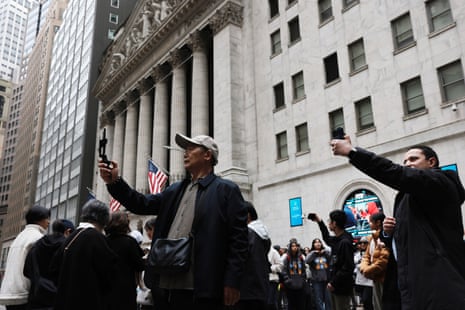
Wall Street has hit a six-month low as the Middle East war weighs on investor sentiment at the New York stock exchange.
The S&P 500 and the Nasdaq have both dropped to their lowest levels since September, sparking speculation that Donald Trump had ‘lost his grip' on markets.
Oil has risen again, with Brent crude up 3.4% at $111.68 a barrel, as traders shrug off Trump's 10-day extension for Iran to open the strait of Hormuz.
The Middle East conflict has also hit US consumer confidence this month.
UK government borrowing costs have risen above 5% amid an intensifying global bond market sell-off fuelled by the Iran war.
The yield – or interest rate – on 10-year debt hit its highest level since the 2008 financial crisis, rising 13 basis points to 5.081%, as investors acted on concerns about the economic fallout from the conflict.
The boss of Asda has warned of “temporary shortages'†at petrol pumps as supplies are squeezed by the conflict in the Middle East, which has driven up average UK petrol prices to above 150p a litre.
Fewer cars rolled off UK production lines in February in what the industry called an “extremely worrying†slump even before the impact of the Iran war was felt.
Vehicle production was 17% lower last month on the same period in 2025, according to the Society of Motor Manufacturers and Traders, as exports dropped sharply.
The UK competition watchdog has launched investigations into five companies including Autotrader and Just Eat over concerns they have not done enough to tackle fake and misleading online reviews.
While Wall Street slides, the UK's major stock index has ended the day little changed.
The FTSE 100 has closed for the week at 9,967 points, down just 5 points or 0.05% today.
Mining stocks and banks rose, while housebuilders fell as traders almost fully priced in three interest rate hikes from the Bank of England this year.
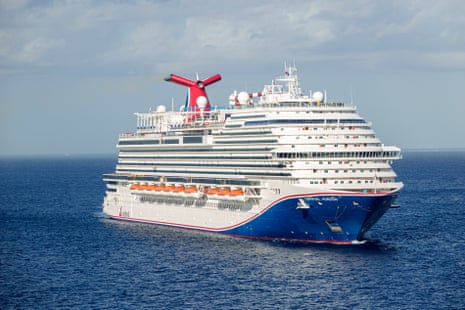
Cruise operator Carnival has cut its full-year profit outlook today, as surging crude prices drive up its fuel costs.
The Miami-based cruise operator now expects full-year earnings of about $2.21 per share, down from $2.48 forecast in December.
In its latest financial results, Carnival flags that it faces a “headwind of over $500m from higher fuel pricesâ€.
Adam Vettese, market analyst for eToro, says:
double quotation mark “Carnival Corporation delivered another set of record Q1 results this morning, with revenue up 6%, adjusted EBITDA hitting $1.27bn and EPS beating forecasts at 20 cents. Bookings for 2026 are running at double-digit growth and the order book is already 85% full at premium prices which would indicate the post-pandemic cruise boom is still very much alive.“The new “PROPEL†long-term plan, backed by a $2.5bn share buyback and a pledge to return roughly $14bn to shareholders over the next few years, is exactly the sort of capital-return discipline the market had been waiting for.
“That said, investors are punishing the stock, which is down around 5% today. The villain is fuel: higher oil prices will cost the group more than $500m this year and ongoing geopolitical tensions threaten to perpetuate this scenario. As a result profit guidance has been cut and that seems to be what the market has focused on despite the solid update.â€
Dollar/yen exchange rate hits 160
In another sign of market tensions, Japan's yen has fallen to its lowest level against the US dollar since July 2024.
The yen/dollar exchange rate has weakened to ¥160 to the $, a significant level that could prompt Japanese financial intervention to prop up the currency.
The weakness comes hours after Tokyo's government warned that the spike in oil prices amid the Middle East crisis could lead to lasting inflationary pressure in Japan's economy over ​the next few quarters.
Oil companies are rallying today, with Chevron up almost 2%.
Some tech firms are leading the Wall Street fallers, though – with Datadog down 6.7% and CrowdStrike losing 5.5%.
Cybersecurity firms are under pressure after a leak suggested Anthropic's latest AI model is better at cybersecurity-related tasks than Claude Opus 4.6.
Investors are shying from risk as the weekend approaches, says Joe Mazzola, head trading & derivatives strategist at Charles Schwab, adding:
double quotation mark Stocks hit nearly seven-month lows Thursday in the worst session since the war began and slid again early today as war raged without signs of a resolution.Brent crude climbed back above $110 per barrel and U.S. Treasury yields rallied to nearly nine-month highs on inflation fears. Major indexes are on pace for the fifth straight lower week, a streak last achieved during the miserable market year of 2022.â€
Wall Street hits six-month low as Trump ‘appears to lose his grip on markets’
The US stock market has dropped to its lowest level since last September, as analysts warn that president Trump may be losing his grip on the markets.
The S&P 500 index has dropped by 0.8% today to 6,425 points, adding to Thursday's 1.75% fall on the benchmark US stock market index.
The tech-focused Nasdaq index is down 1%, also at a six-month low.
Stocks are falling despite Trump's decision, after markets closed yesterday, to pause any attack on Iranian energy plants for a further 10 days.
That extension has been seen as the latest example of a Taco moment (Trump always chickens out) – a term created almost a year ago when the president u-turned on his Liberation Day trade war.
But with oil rising today (Brent crude is up 2.75% at $111 a barrel), the effect of the Taco appears to be waning.
Fawad Razaqzada, market analyst at Forex.com, says:
double quotation mark Trump appears to be losing his grip on the markets. Investors no longer seem to take his statements at face value—if anything, they're beginning to trade against them, waiting for tangible proof before reacting. That's an uncomfortable position for any policymaker to be in. It doesn't help that Israel reported new air strikes on Tehran and Isfahan, while Iran announced a fresh wave of missile strikes against Israel.But going back to the point of TACO becoming ineffective, oil prices fell by roughly $4.50 a barrel yesterday following Trump's latest post about extending the pause on planned strikes against Iran's energy infrastructure. But the move was notably more muted than Monday's sharp sell-off in oil and rally in equities, and it was unwound far more quickly. The oil market, in particular, seems to be growing increasingly desensitised to the rhetoric.
My colleague Eduardo Porter has written about Trump's waning power to shape events, and influence the markets, here:
US consumer confidence hit by Iran war
US consumer confidence has dropped this month, as the Iran war pushes up fuel prices across the States and hits the stock market.
The University of Michigan's consumer morale report shows that sentiment fell back 6% this month to its lowest level since December 2025.
Its Index of Consumer Sentiment has fallen to 53.3 points this month, down from 56.6 in February, with consumers less positive about current economic conditions and future economic prospects.
Surveys of Consumers director Joanne Hsu says weathier Americans were most concerned about the situation:
double quotation mark Declines were seen across age and political party. Consumers with middle and higher incomes and stock wealth, buffeted by both escalating gas prices and volatile financial markets in the wake of the Iran conflict, exhibited particularly large drops in sentiment.Overall, the short-run economic outlook plunged 14%, and year-ahead expected personal finances sank 10%, while declines in long-run expectations were more subdued. These patterns suggest that, at this time, consumers may not expect recent negative developments to persist far into the future.
Here's Luke Bosdet, the AA's spokesman, on the situation in UK road fuel prices today:
double quotation mark “Fuel price averages provided to the AA show that supermarkets last week were averaging more than 5p a litre cheaper for petrol and diesel. Pump price increases this week suggest that the superstores may now be beginning to catch up with oil companies and independents.“Drivers are canny enough, helped by fuel price apps, to spot where to find the cheaper fuel and head to those stations. However, the smart ones will also know that, where they may have to wait to fill up or there is some kind of disruption, another fuel station is likely just down the road with prices a bit more expensive but without having to waste money in a queue.
“The fuel trade media has highlighted instances of disrupted deliveries but these have been sporadic and quickly rectified in a matter of hours – with drivers able to go elsewhere meantime.â€
Iran war causing ‘temporary shortages' at some petrol pumps, says Asda boss
The boss of Asda has warned that some petrol pumps are witnessing “temporary shortages†amid tight supply linked to the conflict in the Middle East and higher demand.
Allan Leighton, executive chairman of Asda, blamed elevated demand from customers for causing a small number of local “spikesâ€, but insisted the issues are not nationwide.
Leighton also rejected accusations that petrol sellers might be “profiteering†from higher pricing in recent weeks.
He told PA Media that the issue has only affected “the odd pump†at a small number of its petrol forecourts, highlighting no forecourts have been fully short of fuel.
He said:
double quotation mark “Our fuel volumes are up quite significantly and clearly demand has been outstripping supply.Supply is tight and we are all trying hard on that.
The issue is a temporary one, and some could see issues when we are waiting for delivery, and we can expect to see that continue.
The spikiness at the moment makes this tricky for us, as spikes can lead to temporary shortages. These are temporary and are addressed very quickly.â€
Two Chinese container ships have turned backed after trying to exit the Gulf via the Strait of Hormuz on Friday, ship-tracking data reported by Reuters shows.
The CSCL Indian Ocean and CSCL Arctic Ocean, both Hong Kong flagged, have been stuck in the Gulf since the U.S.-Israeli war with Iran began late last month.
They attempted to pass through the strait at 0350 GMT on Friday but then turned back, analysis from the Kpler data platform showed.
Wall Street falls despite Trump’s 10-day extension
Donald Trump's decision to give Iran ten days to open up the strait of Hormuz has not brought cheer to Wall Street.
Stocks are falling in early trading in New York, a day after the worst session since the Iran war began.
The Dow Jones industrial average has dropped by 411 points, or 0.9%, at the start of trading to 45,548 points.
The broader S&P 500 share index is down 0.7% at 6,427.43.
David Morrison, senior market analyst at financial services provider Trade Nation, points out:
double quotation mark Moves are headline driven. But the simple fact is that sentiment is likely to stay negative for as long as the Strait of Hormuz remains unsafe for shipping and controlled by Iran.