Key events
Please turn on JavaScript to use this feature
We're closing this page now but our live coverage continues on a new blog here, including a snapshot of the latest key developments. Thanks for following along.
Trump blasts Pope Leo after pontiff denounces ‘delusion of omnipotence’
Donald Trump has launched a scathing attack on Pope Leo XIV, saying he is “weak on crime and terrible for foreign policy†and is hurting the Catholic church.
The US president also posted on his Truth Social platform that it was only because he was president that the US-born Leo became pope.
Trump said in the post:
double quotation mark Unfortunately, Leo's Weak on Crime, Weak on Nuclear Weapons, does not sit well with me…Leo should get his act together as Pope, use Common Sense, stop catering to the Radical Left, and focus on being a Great Pope, not a Politician. It's hurting him very badly and, more importantly, it's hurting the Catholic Church!
Trump's attack came after Leo denounced the “delusion of omnipotence†as fuelling the US-Israel war in Iran and demanded political leaders stop and negotiate peace.
Leo also presided over an evening prayer service in St Peter's Basilica on Saturday as the US-Iran talks began in Pakistan amid the fragile ceasefire, the Associated Press reports
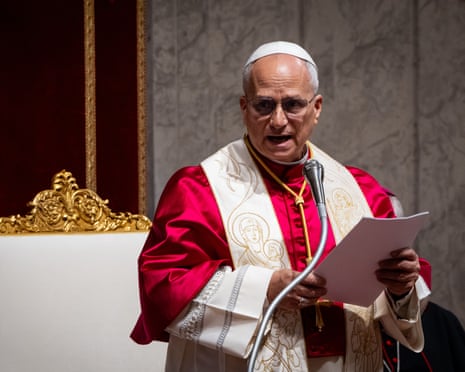
The pope didn't mention the US or Trump by name in his prayer but the pontiff's tone and message appeared directed at Trump and US officials, who have boasted of US military superiority and justified the war in religious terms.
Trump spoke to reporters in Maryland soon after his social media post and said: “I don't think he's doing a very good job,†adding that “I'm not a fan of Pope Leoâ€.
Donald Trump's vow to block the strait of Hormuz came after the weekend US-Iran talks failed to reach a deal. But the two sides turned up in Pakistan to test each other's resolve, writes Patrick Wintour – and it was probably unrealistic to expect a long-running dispute to be settled in one marathon session.
The report from the Guardian's diplomatic editor says:
double quotation mark It was as if the two delegations in the Iran-US peace talks in Islamabad hoped that the sheer number of negotiators flown into Pakistan could overcome the handicap of having only a finite number of hours in which to settle a 20-year dispute over Iran's nuclear ambitions, now overlaid by complex new issues such as future control of the strait of Hormuz and US compensation for its attack on Iran.Iran sent two planeloads of negotiators … The US sent not just the vice-president, JD Vance, but nearly 300 other officials.
Vance spoke to Donald Trump at least a dozen times during the talks, and even once to Israel's Benjamin Netanyahu … But it was probably unrealistic to expect issues that took up two years of negotiations in Vienna between 2013 and 2015 over the nuclear deal to be resolved in one marathon session.
Robert Malley, a veteran of nuclear talks with Iran under Joe Biden, noted pithily: “Twenty-one hours was 20 hours too many if the goal was to reiterate a demand Iran had already rejected. It was many hours too few if the goal was to negotiate.â€
See the full report here:
Australian shares fall after Trump announces Hormuz strait blockade

Jonathan Barrett
The Australian share market dropped sharply on Monday morning after US-Iran peace talks broke down and Donald Trump said the navy would blockade the strait of Hormuz.
The S&P/ASX 200 fell 0.8% to trade at the 8,890 point mark in the opening minutes of trading. The benchmark had been poised to open higher, according to futures pricing over the weekend, before the breakdown in peace talks spooked traders.
Market strategy consultant Greg Boland, from trading platform Moomoo, says the increase in geopolitical tension will weigh on market sentiment.
double quotation mark The potential for US naval action around the strait of Hormuz raises the risk of disruption to global oil supply, which could feed directly into inflation expectations and complicate the outlook for central banks.â€
Oil prices have also risen back above the $US100 a barrel this morning, according to futures pricing.
Global equity markets have been pulled up and down by the Middle East conflict given energy disruptions and increased oil costs contribute to global inflation by elevating costs across nearly all goods and services.
Iran's parliamentary speaker, who led Tehran's negotiators at the weekend talks with Washington, has taunted Donald Trump over petrol prices amid the US president's vow to blockade the strait of Hormuz.
Mohammad Bagher Ghalibaf posted on X above an image appearing to show prices per gallon at gas stations in the White House area:
double quotation mark Enjoy the current pump figures. With the so-called ‘blockade', Soon you'll be nostalgic for $4–$5 gas.â€

Nick Visser
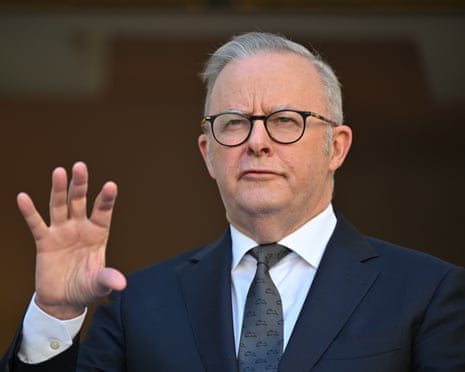
Australia's prime minister has said his government wants to see negotiations between the US and Iran continue and that Australia has not been asked to participate in any US blockade of the strait of Hormuz.
Anthony Albanese told Channel 9 television on Monday morning:
double quotation mark We haven't been asked to participate. We've received no requests. We haven't been asked … and I don't expect that we will be.What we want is for negotiations to resume. We want to see an end to the loss of life and the loss of infrastructure… in the Middle East. And we want to see trade resume.
This is having a massive global economic impact, not just on Australia. Every single country is being impacted.â€
The war with Iran has cost Israel about 35bn shekels (US$11.5bn) in direct budgetary expenses, according to preliminary estimates from the Israeli finance ministry.
The ministry said the war – involving Israel and the US against Iran – had inflicted severe economic damage, including a significant contraction of GDP and a surge in government spending.
Officials warned that the full financial impact – including long-term reconstruction and economic recovery costs – might not be fully realised for some time.
The largest portion of the budget was consumed by the Israel Defence Forces, the defence ministry, the national security ministry and various intelligence organisations.
Trump considering limited military strikes against Iran – report
Donald Trump and his advisers are looking at resuming limited military strikes in Iran in addition to the US blockade of the Hormuz strait as a way to break a stalemate in peace talks, the Wall Street Journal is reporting, citing officials and people familiar with the situation.
That was among the options the president was considering on Sunday, hours after negotiations collapsed in Pakistan, the report quoted the officials as saying.
It continued:
double quotation mark Trump could also resume a full-fledged bombing campaign, though officials said that was less likely given the prospect of further destabilizing the region and the president's aversion to prolonged military conflicts. He could also seek a more temporary blockade while he pressures allies to take responsibility for a prolonged military escort mission through the strait in the future.
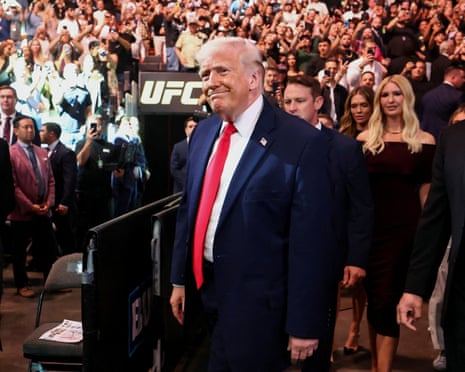
After the collapse of the US-Iran talks in Pakistan, Trump spent much of Sunday at his resort in Miami, calling in to a Fox News show, golfing and talking with advisers, the report said. He remained open to a diplomatic solution, aides said, even as he promised the blockade and threatened again to target Iran's infrastructure.
A White House spokesperson declined to discuss Trump's specific options, the report said.
Summary of the day so far
-
Trump said the US Navy would start blockading the strait of Hormuz and would also interdict every vessel in international waters that had paid a toll to Iran. In a lengthy Truth Social post, he said the US was going to start “BLOCKADING any and all Ships trying to enter, or leave, the Strait of Hormuzâ€.
-
In another post Trump also claimed that Iran had “knowingly failed†to make good on its promise to open the strait, causing “anxiety†and “pain†for many countries around the world.
-
US Central Command (Centcom) announced it would begin its blockade of the strait beginning Monday morning. “Centcom forces will begin implementing a blockade of all maritime traffic entering and exiting Iranian ports on April 13 at 10am ET [1400 GMT], in accordance with the president's proclamation.â€
-
Iran's Revolutionary Guard warned in its latest statement that “approaching military vessels to the strait of Hormuz is considered a violation of the ceasefireâ€.
-
Trump reiterated his threat to destroy Iran's power plants and other civilian energy infrastructure if no deal is reached to end the war, which he started with Israel in what is widely seen as an illegal and unprovoked attack. “I could take out Iran in one day,†he told Fox News on Sunday.
-
Trump also said the US didn't need the strait. “We don't get our oil from there. We have so much oil,†the US president told Fox. “We have boats pouring up to the United States … We don't need the strait.â€
-
Iran's top negotiator, Mohammad Baqer Qalibaf, said Trump's new threats would have no effect on the Iranian nation. “If you fight, we will fight, and if you come forward with logic, we will deal with logic. We will not bow to any threats.â€
-
Oil prices rose in early trading on Sunday after Trump's vow over the Hormuz strait, with US crude increasing 8% to $104.24 a barrel and Brent crude rising 7% to $102.29.
Oil prices rise after Trump blockade vow
More on the oil price lift: the price of US crude increased 8% to $104.24 a barrel and Brent crude oil rose 7% to $102.29 in early market trading on Sunday after Donald Trump said the US would blockade Iranian ports starting on Monday.
The AP reports that Brent crude – the international standard – has swung dramatically during the Iran war, rising from roughly $70 a barrel before the war in late February to more than $119 at times.
On Friday, ahead of the peace talks in Pakistan, Brent for June delivery fell 0.8% to $95.20 a barrel.
Iran has been effectively controlling the strait of Hormuz, a key waterway for global oil and LPG shipping. US Central Command said the blockade would be “enforced impartially against vessels of all nations†entering or departing Iranian ports and coastal areas.
It said it would still allow ships traveling between non-Iranian ports to transit the strait of Hormuz.
About a fifth of the world's traded oil typically flows through the strait of Hormuz every day. Saudi Arabia, Iraq, the United Arab Emirates, Kuwait and Iran are all major exporters.
Oil prices have reportedly risen in early market trading after Donald Trump said the US would blockade the strait of Hormuz following the failure of weekend peace talks.
Iran's minister of foreign affairs, Abbas Araghchi, said that yesterday's negotiations between the US and Iran actually came close to agreement at some point, but ultimately fell apart due to the US “shifting goalposts.â€
“In intensive talks at the highest level in 47 years, Iran engaged with US in good faith to end the war,†he wrote. “But when just inches away from ‘Islamabad MoU', we encountered maximalism, shifting goalposts, and blockade. Zero lessons earned. Good will begets good will. Enmity begets enmity.â€
Mohammad-Bagher Ghalibaf, Parliament speaker of Iran, also chimed in to remind the White House of rising gas prices in the US.
“Enjoy the current pump figures,†he wrote. “With the so-called ‘blockade', soon you'll be nostalgic for $4–$5 gas.â€