Introduction: Alphabet to raise $80bn for AI spending
Good morning, and welcome to our rolling coverage of business, the financial markets and the world economy.
The economics of the AI boom are back in focus today, after Google's parent company Alphabet said it plans to raise up to $80bn in equity to – in part – fund its vast AI infrastructure investments.
The move is one of the largest equity raisings ever, and includes a $10bn share sale to investsment giant Berkshire Hathaway
Alphabet, whose Gemini AI system has been growing its share of the AI chatbot market, says it will use the money to expand its “world-class AI compute infrastructure to meet its unprecedented customer demand.â€
The company says:
double quotation mark AI is driving an expansionary moment for Alphabet. The company is experiencing strong demand for its AI solutions and services from enterprises and consumers, at levels that are exceeding the company's available supply. By scaling its investments, the company seeks to expand its foundational infrastructure to support the significant growth opportunity ahead.
But, such a huge fundraising is also a warning to the markets that, for all the many billions of dollars thrown at AI infrastructure, meaningful returns are limited.
Jim Reid, market strategist at Deutsche Bank, told clients that Alhabet is reminding investors of the “unprecedented scale of the AI spending boomâ€, adding:
double quotation mark “Funding of the AI capex boom is becoming an increasingly key topic for markets.â€
The decision to tap Berkshire Hathaway is eye-catching too. Under the now-retired Warren Buffett, Berkshire made a habit of stepping in to provide important, and lucrative, funding for companies who really needed cash, such as the famous $5bn investment into Goldman Sachs at the height of the financial crisis.
In its filing, Alphabet explains that half the $80bn will be dedicated to “scale AI infrastructure and global computeâ€, with $40bn set aside to cover “an administrative change to how it meets tax obligations associated with vesting of employee equity awardsâ€.
Alphabet is also tapping investors before some of its largest AI rivals attempt to join the stock market.
Yesterday, Anthropic -which makes the Claude chatbot – said it had filed confidentially for an initial public offering on the US stock market.
Anthropic is now valued at $965bn after raising $65bn in funding, meaning it has leapfrogged OpenAI to become the world's most valuable startup.
The agenda
-
9.30am BST: Bank of England mortgage approvals and consumer credit data
-
9.45am BST: Treasury Committee session on student loans
-
10am BST: Eurozone inflation report for May
-
3pm BST: US JOLTS vacancies report
-
3pm BST: Bank of England governor Andrew Bailey: Oral evidence to the Lords Economic Affairs Committee
Key events
Alphabet’s shares fall 4% after $80bn share sales announced
Over on Wall Street, shares in Alphabet have dropped at the start of trading after it announced $80bn of share sales last night.
Alphabet's share price is down by 4% in early trading to $361.10.
That's down from its closing level of $376.37 on Monday night, which valued Google's parent company at over $4.5trn.
As explained in the introduction of this blog, Alphabet is raising $40bn to fund its “AI infrastructure and global computeâ€, plus another $40bn to cover costs such as “tax obligations associated with vesting of employee equity awardsâ€.
Analysts say this secondary share offering is the largest on record, dwarfing the amount raise in the world's largest IPOs.
Though economists still debate whether AI will destroy jobs or create them, the prevailing mood in Silicon Valley is far more pessimistic, writes Harvard professor Ken Rogoff:
double quotation mark Either your startup makes it within the next five to ten years, the conventional wisdom holds, or you'd better pray the government provides a generous universal basic income.Despite President Donald Trump's efforts to pull Silicon Valley into the Maga orbit, American-style progressivism continues to dominate Bay Area culture. Most of California's young tech strivers still see themselves as dyed-in-the-wool progressives –enthusiastic supporters of taxing the rich, at least until they become rich themselves.
Yet for all their virtue signaling, Silicon Valley elites seem strangely oblivious to the fact that the vast majority of people left behind by the rise of AI will not live in the US. Nor will they live in countries that have secured a place in the AI supply chain, such as South Korea, Japan, and Taiwan.
While South Korean firms such as Samsung and semiconductor company SK Hynix have become trillion-dollar giants on the back of AI's insatiable demand for advanced memory chips, Europe has produced far fewer success stories. ASML, the Dutch firm that holds a near-monopoly on the high-end lithography machines needed to manufacture the world's most advanced semiconductors, is a rare exception. The picture is even bleaker in Africa and Latin America, which have yet to produce anything remotely comparable
British Land appoints Joanne McNamara as CEO

Julia Kollewe
British Land, one of the UK's biggest property developers, has appointed Joanne McNamara as its new chief executive, a senior executive from the real estate arm of a Canadian pension fund.
She will succeed Simon Carter, who quit in January after over five years as CEO of British Land and 18 years at the company. He is taking the reins at P3 Logistics Parks, an investor, manager and developer of warehouses in Europe owned by Singapore's sovereign wealth fund GIC.
McNamara currently runs the European business at Oxford Properties, a global real estate investor, developer and manager owned by the Ontario Municipal Employees Retirement System, one of Canada's largest pension funds.
She will be one of just a handful of female bosses at FTSE 100 companies, and a rare female leader in the male-dominated real estate sector.
McNamara has more than 20 years' experience in real restate, and joined Oxford Properties in 2010 as one of its first team members in London, where she built a 70-plus European team and a portfolio of offices, retail, housing and warehouses worth £8bn. She previously worked at the developer Hammerson and the investment group DTZ.
She is expected to join British Land by the end of November at the latest after her notice period.
“Joanne is one of Europe's most respected real estate professionals,†said William Rucker, chair of British Land. “With her deep expertise of real estate, valuable experience in the world of private capital and a strong reputation for decisive leadership, she is exceptionally well placed to drive the business forward.â€
McNamara said:
double quotation mark “British Land is a business that I have always admired, with an impressive track record of delivering and managing best in class places across the UK and an expert team at its helm.â€
British Land and Oxford Properties teamed to build the Leadenhall Building in the City, known as the Cheesegrater, which opened in July 2014
Iran's year-on-year inflation reached a record high in May, the worst since World War II, Associated Press report.
The Iranian consumer price index rose 77.2% in May compared to the previous year.
Inflation in daily and general needs — like medicine, taxi fares, tobacco and communication fees — rose 113.8% from the year before.
Oil price drops on Middle East peace hopes
The AI boom is one of two issues dominating the markets at the moment.
The other is the Middle East conflict, where investors are looking for signs of a breakthrough in the US-Iran peace talks.
Today, the oil price has dipped by around 1% after Donald Trump hailed an agreement to de-escalate the fighting in Lebanon.
Trump said Hezbollah, through intermediaries, had pledged not to attack Israel, while Israeli prime minister Benjamin Netanyahu agreed to pull back any troops preparing to attack Beirut.
That's helped to push Brent crude down to $93.90 a barrel, a day after oil prices jumped as relations between Tehran and Washington DC appeared to deteriorate.
Stock markets are a little higher today too, with the FTSE 100 share index up 0.3%.
“Oil down, markets up – these are welcome movements for investors after three months of uncertainty around the Iran war,†says Russ Mould, investment director at AJ Bell, adding:
double quotation mark “Brent crude fell 1.1% to $93.90 after Israel halted strikes on Lebanon, raising hopes that a peace deal is still plausible.The further the oil price retreats from the $100 per barrel level, the greater investors' risk appetite. This explains why miners and consumer cyclical stocks led the charge on the FTSE 100. Defensive-style sectors including healthcare and utilities didn't fare as well as there was classic portfolio rotation.
Nvidia's Jensen Huang says Marvell could be the next trillion-dollar company
Shares in semiconductor firm Marvell Technology have surged by 25% in premarket trading after Nvidia CEO Jensen Huang called the chipmaker the next “trillion-dollar company.â€
Huang made the comments at the Computex trade show in Taipei, where he was appearing alongside Marvell CEO Matt Murphy.
Huang explained that Marvell's networking and connectivity chips are essential to data centres; they share computing tasks between thousands of connected chips, saying:
double quotation mark “When you take a computing problem, and you disaggregate it into a lot of parts, and you distribute it across the entire data center, what's necessary is connectivity.That's the reason why Matt's doing so well. That's the reason why Marvel is so essential.â€
Before Huang's comment, Marvell's was valued at almost $192bn.
Last week, chipmakers SK Hynix and Micron hit the $1tn mark for the first time.
Hargreaves Lansdown: Alphabet AI share sale dwarfs previous fundraises
Alphabet's new $80bn share sale appears to be the largest equity raising ever, suggests Nicholas Hyett​, lead alternatives analyst at Hargreaves Lansdown.
Hyett explains that the stock sale is much larger than previous secondary share sales of this time, and is also raising more money than the largest stock market flotations (‘initial public offerings', os IPOs).
Hyett says:
double quotation mark “Alphabet's $80bn fundraise dwarf's the world's largest IPOs, often the moment of maximum excitement when companies seek to fill their financial warchests. In fact, if successful, it would raise more than the world's three largest initial public offerings put together – Saudi Aramco raised $25.6bn when it debuted on the Saudi exchange in 2019; Alibaba raised $21.8bn on NYSE in 2014, and SoftBank raised $21.3bn when it listed in Tokyo in 2018.We can't think of a secondary issue that would even come close to matching the ambition of this fundraise – $80bn would be enough to buy the 137th member of the S&P 500 outright, and there just aren't many companies in the world that have the ability to spend that amount of money productively.â€

Jasper Jolly
Wessex Water has announced the retirement of its chief financial officer, Andy Pymer, in the latest shake-up at the top of the utility owned by Malaysian group YTL.
Pymer will be replaced later this year by Richard Eadie, executive finance director at Anglian Water Services. Eadie will serve under Ruth Jefferson, who replaced long-serving chief executive Colin Skellett in October 2024.
Pymer served as chief financial officer from 2020, during one of the most turbulent and scandal-hit periods ever for the water industry.
The pay of Pymer and Jefferson came under scrutiny after the Guardian reported on previously undisclosed payments, worth a combined £50,000. The payments were made to the pair by other companies in the YTL Group in the same year that the company was banned from paying bonuses – although Wessex denied they were bonus payments. Pymer's pay for the last financial year from the regulated water company was £249,000.
The Guardian's reporting on the pay arrangements prompted questions in parliament. A junior environment minister, Emma Hardy, said the Wessex situation “baffles meâ€.
She added:
double quotation mark “If performance is not good enough, people should not get a bonus.â€
Ruth Jefferson, Wessex's chief executive, said that Pymer “has made an outstanding contribution to Wessex Water over more than three decades, and it has been a great pleasure to work alongside him.â€
Gold overtakes US Treasuries as world's top reserve asset, ECB says
In a landmark moment, gold has overtaken US government bonds as the world's top reserve asset, according to calculations from the European Central Bank.
The ECB says that gold made up 27% of total official foreign reserves at the end of 2025, ahead of US Treasuries (22% of reserves) and the euro (15%).
A year earlier, gold was 20% of reserves.
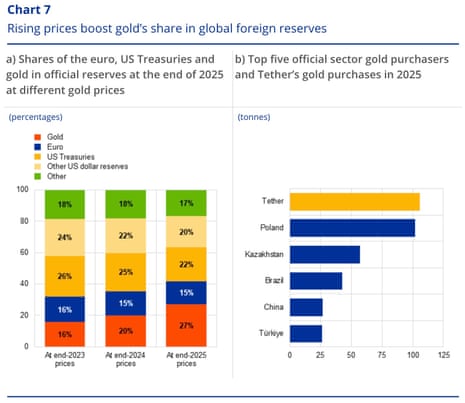
The jump last year was partly due to increased purchases by central banks, as geopolitical tensions have risen.
In a report on The international role of the euro, ECB president Christine Lagarde says:
double quotation mark Forces of fragmentation are becoming more pronounced. Geopolitical tensions continue to drive strong central bank demand for gold.
But the increase in gold holdings is also because the value of bullion jumped over the last two years, meaning the metal held by central banks is much more valuable.
The ECB says:
double quotation mark In nominal terms, the gold price surged by around 60% and 30% in 2025 and 2024 respectively, which mechanically increases the share of gold in total official foreign reserves.Correcting for such valuation effects by using the gold price at the end of 2023, the share of the euro (16%) remains at par with the share of gold (16%), while the share of US Treasuries continues to be markedly higher (26%).
Going forward, gold faces limitations as an official reserve asset compared with the major fiat currencies: its price is volatile, it is not remunerated and, when held in physical form, it is costly to store. More importantly, the supply of gold is not fully elastic and does not adjust seamlessly to shifts in international demand for liquidity.
Eurozone inflation rises to 3.2%
Inflation across the eurozone has risen to its highest level since September 2023, adding to the pressure on the European Central Bank to lift interest rates.
Eurozone consumer price inflation hit 3.2% in May, a new estimate from statistics body Eurostat shows, up from 3% in April.
That means prices are accelerating faster than the ECB's 2% target, which could spur policymakers to vote to raise eurozone interest rates at their meeting next week.
Energy prices drove inflation higher. Energy inflation rose to 10.9% in May, while services rose by 3.5% per year. Food, alcohol & tobacco inflation dropped to 2.0%, while industrial goods inflation rose slightly to 0.9%.
Emeritus professor Joe Nellis, economic adviser at accountancy and advisory firm MHA, says:
double quotation mark Eurozone inflation rose to 3.2% in May as pressure builds on the European Central Bank to act now to combat rising prices. Despite efforts to control it, underlying price pressures remain strong, with service inflation and wage growth persisting, businesses passing on costs, and global instability driving up energy and transport costs. These factors further strain supply chains across Europe.With this uptick in inflation, the ECB is increasingly likely to raise interest rates by 0.25 percentage points next week. This marks a shift from earlier expectations that the ECB might ease policy later this year to reignite the sluggish Eurozone economy.
UK mortgage approvals highest since January 2025
UK mortgage approvals have hit a 15-month high, despite the Middle East crisis driving up interest rates.
The Bank of England has reported that 65,900 mortgages were approved in April, up from almost 64,000 in March, on a seasonally adjusted basis. That's the highest level since January 2025.
However, net borrowing of mortgage debt by individuals decreased to £4.4bn in April, from £6.8bn in March.
Martin Beck, chief economist at WPI Strategy, says:
double quotation mark “Continued resilience in mortgage lending and housing market activity in April suggests the economic fallout from conflict in the Middle East has not yet hit household borrowing as hard as some feared. Mortgage approvals rose to a 15-month high of 65,945 in April, up from March's 63,979, while gross mortgage lending, was the second-highest level since March 2025.“Household borrowing is proving surprisingly resilient in the face of geopolitical uncertainty, higher inflation risks and tighter financial conditions. The housing market is far from booming, but it is holding up better than the wider economic backdrop might suggest.
Alphabet shares down slightly
Shares in Alphabet have dipped in pre-market trading, as investors digest its planned $80bn stock sale.
They're down 1.8% at $369.63.
That's a modest reaction, showing that traders hasn't been spooked.
And that's because the $80bn stock sale won't land on the market in one go. The $40bn “at-the-market (ATM) offering†will raise money for Alphabet over time, as shares are trickled onto the market gradually.
The $30bn of shares sold though the “aggregate underwritten offerings†will be held by the investment banks who underwrite the deal. They wouldn't dump the stock on the market in one go either.
Plus, Berkshire Hathaway could be expected to hold onto its new $10bn stake, as it has been investing in Alphabet for a while.
Alphabet's shares are up 126% over the last year.
Nearly a fifth of young people set to be unemployed next year as AI hits jobs market
Youth unemployment in the UK is set to hit almost 18% next year, as the rollout of AI systems destroys some entry level jobs.
The British Chambers of Commerce has predicted that the UK's youth unemployment rate will rise to 16.9% this year, up from 16.1% in the last quarter of 2025, and then hit 17.88% in 2027.
That would mean that almost a fifth of young people would be out of work next year.
The BCC blamed higher taxes, minimum wage rises and the rise of AI, saying:
double quotation mark Youth unemployment remains an area of concern as labour costs and AI erode entry level jobs. It is expected to be 16.9% in 2026, rising to 17.8% in 2027.With firms facing squeezed margins because of input costs and minimum wage increases, growth in average earnings is forecast to ease from 3.7% by Q4 2026 to 3.3% by the end of 2027.
Last week, former health secretary Alan Milburn warned that the number of young people not in education, employment or training risked creating a ‘lost generation':
The BCC has also trimmed its forecast for UK growth this year to 0.9%, down from 1.0% previously forecast.
It warned:
double quotation mark The Middle East conflict is a major economic drag, with business investment now expected to fall by 2.2% this year, before moving back to –0.1% in 2027.
Third economic pole needed to protect from ‘Trump shock’

Lisa O'Carroll
A new economic alliance between the EU and like-minded Asian allies should be set up to save the world's economies from “Trump shockâ€, a new report by Chatham House, the foreign affairs think tank, says.
It was authored by Creon Butler, former director for international economic affairs in the National Security Secretariat in the UK cabinet office, and a “sous sherpa†at the G7 and G20 summits,
He calls for a “third economic pole†initially be made up of EU countries and members of the Comprehensive and Progressive Trans-Pacific Partnership who are committed to following rules-based trade.
The alliance should exclude the US and China as the former has made a dramatic break from rules while the latter has never fully committed to WTO rules, it argues.
The report says:
double quotation mark “China is far from the only country to behave this way but as the second largest national economy after the US, it has become a highly disruptive influence.â€
Establishing a “third pole†would allow like minded countries to preserve and improve core rules in the largest economic space available with the EU and CPTPP countries between them accounting for 32% of global GDP. Others including the South Korea, Brazil, Turkey and South Africa.
The report adds:
double quotation mark “It is likely only a matter of time before the full suite of Trump policies substantially reduces trend growth and economic stability in the US, and possibly the wider world.â€
The UK would be well position to take the group further. It is also the country likely to be “most damaged†if the current trade disorder prevails, it says, adding the “third pole†is “necessary†regardless of who is in the White House.
Troy Hooper, co-head of equity capital markets for the Americas at the financial intelligence provider Mergermarket, said Alphabet's funding plans underscored the intensity of the race to lead the AI buildout.
Hooper told Al Jazeera:
double quotation mark “For hyperscalers, compute capacity is a direct driver of future revenue.“By leaning into equity, Alphabet is bringing in permanent capital rather than burdening a balance sheet already absorbing record capex [capital expenditure].â€
Tech giants are no longer ‘capital-light free cash flow machines’
Here's the details of Alphabet's $80bn equity raise:
Proposed Offerings
-
Concurrent underwritten offerings: $30 billion underwritten public offerings, consisting of: $15 billion in depositary shares representing mandatory convertible preferred stock; and $15 billion in Class A Common Stock and Class C Capital Stock; and
-
At-the-market offering: $40 billion at-the-market, or ATM, offering program for Class A Common Stock and Class C Capital Stock over time, expected to begin in Q3 2026.
Private Placement:
In addition, Alphabet has reached an agreement to sell $10 billion of stock to Berkshire Hathaway Inc. in a private placement, comprised of $5 billion in Class A Common Stock at a price of $351.81 per share and $5 billion in Class C Capital Stock at a price of $348.20 per share.
Matt Britzman, senior equity analyst at Hargreaves Lansdown, says this marks a shift in the financies of major tech firms:
double quotation mark “Alphabet's $80 billion equity raise is a clear sign that the AI arms race is moving into a more capital-hungry phase, but the structure matters. It's certainly a huge chunk of money to be raising, but the devil's in the details on this.The full $80 billion is less than 2% of Alphabet's mammoth $4.6 trillion market cap, and around half of the total is an initial raise, with a $30 billion offering alongside the $10 billion from Berkshire Hathaway.
The other $40 billion is a flexible drip-feed mechanism that can be used gradually over time, not earmarked for AI investment. But, however it's structured, one thing is abundantly clear. Long gone are the days when the tech giants were capital-light free cash flow machines.
Alphabet's massive share sale, and Anthropic's IPO, are also reminders that an AI crash would have serious consequences for investors, both large and small.
Ipek Ozkardeskaya, senior analyst at Swissquote, explains:
double quotation mark The AI race is no longer being funded solely by venture capitalists willing to lose money for a decade in exchange for a shot at changing the world. The financing is becoming increasingly institutionalized. Just yesterday, Alphabet announced plans to raise $80 billion to fund its AI ambitions – one of the biggest stock deals in history – including a $10 billion investment from Berkshire Hathaway.This means that AI is increasingly becoming a financing story as well. And the deeper traditional finance gets involved, the more the AI story shifts from a technology narrative toward a financing and credit narrative.
What's the risk? A failure of OpenAI or Anthropic – God forbid – would not likely trigger a systemic financial event. But the growing web of equity investments, debt financing, private credit facilities, infrastructure spending and long-term purchase commitments means that AI-related losses are increasingly finding their way into pension funds, insurers, asset managers, corporate balance sheets and the broader economy. We're all in the same boat.
Introduction: Alphabet to raise $80bn for AI spending
Good morning, and welcome to our rolling coverage of business, the financial markets and the world economy.
The economics of the AI boom are back in focus today, after Google's parent company Alphabet said it plans to raise up to $80bn in equity to – in part – fund its vast AI infrastructure investments.
The move is one of the largest equity raisings ever, and includes a $10bn share sale to investsment giant Berkshire Hathaway
Alphabet, whose Gemini AI system has been growing its share of the AI chatbot market, says it will use the money to expand its “world-class AI compute infrastructure to meet its unprecedented customer demand.â€
The company says:
double quotation mark AI is driving an expansionary moment for Alphabet. The company is experiencing strong demand for its AI solutions and services from enterprises and consumers, at levels that are exceeding the company's available supply. By scaling its investments, the company seeks to expand its foundational infrastructure to support the significant growth opportunity ahead.
But, such a huge fundraising is also a warning to the markets that, for all the many billions of dollars thrown at AI infrastructure, meaningful returns are limited.
Jim Reid, market strategist at Deutsche Bank, told clients that Alhabet is reminding investors of the “unprecedented scale of the AI spending boomâ€, adding:
double quotation mark “Funding of the AI capex boom is becoming an increasingly key topic for markets.â€
The decision to tap Berkshire Hathaway is eye-catching too. Under the now-retired Warren Buffett, Berkshire made a habit of stepping in to provide important, and lucrative, funding for companies who really needed cash, such as the famous $5bn investment into Goldman Sachs at the height of the financial crisis.
In its filing, Alphabet explains that half the $80bn will be dedicated to “scale AI infrastructure and global computeâ€, with $40bn set aside to cover “an administrative change to how it meets tax obligations associated with vesting of employee equity awardsâ€.
Alphabet is also tapping investors before some of its largest AI rivals attempt to join the stock market.
Yesterday, Anthropic -which makes the Claude chatbot – said it had filed confidentially for an initial public offering on the US stock market.
Anthropic is now valued at $965bn after raising $65bn in funding, meaning it has leapfrogged OpenAI to become the world's most valuable startup.
The agenda
-
9.30am BST: Bank of England mortgage approvals and consumer credit data
-
9.45am BST: Treasury Committee session on student loans
-
10am BST: Eurozone inflation report for May
-
3pm BST: US JOLTS vacancies report
-
3pm BST: Bank of England governor Andrew Bailey: Oral evidence to the Lords Economic Affairs Committee