US economy adds more jobs than expected in May
Newsflash: the US economy added more jobs than forecast last month.
Total nonfarm payroll employment increased by 172,000 in May, the US Bureau of Labor Statistics has reported, with gains in leisure and hospitality, local government, and health care.
Employment in financial activities declined, though, the BLS reports.
That's much stronger than the 85,000 new jobs which economists had predicted for May.
Jobs data for the previous two months has been revised higher too, the BLS adds:
double quotation mark The change in total nonfarm payroll employment for March was revised up by 29,000, from +185,000 to +214,000, and the change for April was revised up by 64,000, from +115,000 to +179,000.
Those revisions mean employment in March and April combined was 93,000 higher than previously reported – encouraging news for US workers, and the White House, but something which may make US interest rate cuts less likely…
Key events
Closing post
Time to wrap up…
US employers added 172,000 jobs in May while the country's unemployment rate held steady at 4.3%, a sign of a resilient labor market despite rising inflation and economic uncertainty brought on by continued conflict in the Middle East.
Economists initially predicted there would be about 80,000 new jobs and a steady unemployment rate of 4.3%. Job figures for March and April were also revised up 29,000 and 64,000, respectively, a 93,000 boost compared to initial figures.
The new data from the Bureau of Labor Statistics is the latest in a number of reports that have pointed to strong hiring in recent months, despite a strained economy and an increase in inflation.
Wall Street fell as investors ramped up their bets that US interest rates could be hiked by the end of the year.
In other news…
European Union's transport chief has insisted there are no signs of jet fuel shortages in Europe in the coming months.
Transport commissioner Apostolos Tzitzikostas has told Reuters:
double quotation mark “There is currently no jet fuel shortage in Europe. We have no signs that we will have a shortage in the coming period.â€
London's stock market has closed for the week, with the FTSE 100 blue-chip index little chagned at 10,368 points, up 7 points today.
Mining stocks fell, while London's defensive stocks such as tobacco firms and consumer goods makers rallied.
The smaller FTSE 250 share index fell 1%, despite a roaring performance from computer maker Raspberry Pi. Its share surged 27% after lifting its profit forecast this morning.
The sell-off on Wall Street is continuing, with the Nasdaq Composite index now down 2% or -535 points at 26,295 points.
Hospitality jobs boom as US prepares for World Cup
The men's World Cup, which kicks off later this month, may have helped drive up hiring in May.
The BBC reckons that pubs, bars and restaurants ramped up hiring ahead of the World Cup, contributing to the 70,000 new jobs at hospitality firms last month.
Trump: Market should be up, not down
Donald Trump is unhappy that Wall Street is falling.
Posting on Truth Social, the US president claims the market should be going up:
double quotation mark With a great Jobs Report, like just announced, stocks should go up, not down. That's the way it was for 200 years. Growth does not mean inflation! How else can a Country attain GREATNESS??? President DJT
New York traders aren't convinced, though. The S&P 500 is now down 0.9%, with the Nasdaq Composite down by 1.6%.
Precious metal prices are also falling, as the US dollar strengthens.
Silver is down 5.4% at $69.87 an ounce, with gold down 2.1% at $4,377 an ounce.
Tech stocks on the slide today include storage firm Western Digital (-8.7%), Super Micro Computer (-8.1%), Sandisk (-7.5%) and Micron (-7.7%).
Wall Street's latest dilemma is whether to celebrate a strong economy or fear higher interest rates, says Rich McDonald, market analyst at investing and trading platform IG:
double quotation mark US employers added 172,000 jobs in May, comfortably ahead of expectations, while unemployment held steady at 4.3%. Wage growth remained contained, suggesting the labour market remains healthy without reigniting inflation concerns.
Ordinarily, that would be a reason for stocks to rally. Instead, investors focused on the prospect that a resilient economy could increase the need for a Federal Reserve rate hike later this year.
The benchmark 10-year Treasury yield rose from 4.47% to 4.53% following the release, reflecting expectations that interest rates may move higher and for longer.
Wall Street falls after strong jobs report
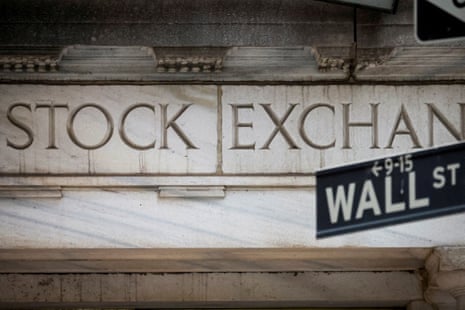
The US stock market has opened in the red, as traders react to today's better-than-expected jobs report.
With hopes of interest rate cuts this year fading fast, the S&P 500 share index has dropped by 47 points, or 0.6%, in early trading to 7537 points.
Technology stocks are among the fallers, as concern grows that the boom in AI-related stocks may be faltering.
This has pulled the Nasdaq Composite index down by 301 points, or 1.13%, to 26,529 points.
Traders fully price in Fed rate hike this year after jobs data
Financial traders are now fully pricing in a Federal Reserve interest-rate hike by the end of this year, after May's surprisingly strong jobs report, according to Bloomberg.
That will not please president Trump, who repeatedly attacked former Fed chair Jerome Powell for not cutting rates faster.
Isaac Stell, investment manager at Wealth Club, thinks the markets are right, though. With strong job creation, and inflationary pressure from the Iran war, a rise in US interest rates does look more likely….
Stell explains:
double quotation mark The Fed now faces a more complex policy backdrop. Inflation has risen sharply, reaching 3.8% in April from 2.4% at the start of the year, driven in part by the continued disruption in the Strait of Hormuz. With inflation pressures building and the labour market remaining robust, the bar for rate hikes continues to fall, increasing the likelihood of further policy tightening in the near term.â€
US government bonds are under pressure as investors conclude that early rate cuts are highly unlikely.
This has pushed up the yield, or interest rate, on US two-year Treasury bills to 4.147%, the highest since February 2025, Reuters reports.
Such strong jobs growth will make it tricky for America's new top central banker to push for interest rate cuts.
Seema Shah, chief global strategist at Principal Asset Management, says Kevin Warsh may find himself considering raising interest rates later this year, despite Donald Trump's demands for lower borrowing costs:
double quotation mark “Today's jobs report reinforces that there is little basis for an easing bias from the Fed. Job creation above 150,000 – very comfortably exceeding the Fed's estimate of breakeven and also broad-based in nature – comes alongside inflation that remains above target and is expected to trend higher in coming months. In effect, both sides of the Fed's dual mandate argue against rate cuts at this stage.“If Chair Warsh pushes for cuts at his first meeting, he will be pushing against the evidence. Our base case remains that the Fed stays on hold through 2026, but if employment data continues to track around May's pace, rate hikes this year would come firmly into play.â€