
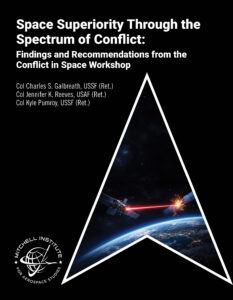
Arlington, VA | June 23, 2025 — The Mitchell Institute for Aerospace Studies is pleased to announce a new entry in its Research Studies series, Space Superiority Through the Spectrum of Conflict: Findings and Recommendations from the Conflict in Space Workshop by Col Charles Galbreath, USSF (Ret.), Director and Senior Resident Fellow for Space Studies; Col Jennifer Reeves, USAF (Ret.), Senior Resident Fellow for Space Studies; and Col Kyle Pumroy, USSF (Ret.), Senior Resident Fellow for Space Studies at the Mitchell Institute's Spacepower Advantage Center of Excellence (MI-SPACE).
The Mitchell Institute held a two-day unclassified workshop in January 2026, bringing together more than fifty experts from the military, government, industry, allied forces, and academia to examine how conflict in space may emerge, evolve, and be managed across the spectrum of military engagement, from competition to armed conflict. Using recently released U.S. Space Force and U.S. Space Command doctrinal documents as a foundational context, participants engaged in a structured series of near-term scenarios that represented escalating hostile actions across multiple geographic combatant commands.
The scenarios were designed to stress key variables, including attribution, intent, type of weapons used, capability affected, and relation to other geopolitical conditions, without exposing real-world vulnerabilities. Workshop discussions highlighted the inherent complexity of space as a domain that defies traditional geographic and legal constructs, complicates attribution, and enables adversaries to normalize coercive behavior below clear thresholds of armed conflict. This ambiguity favors competitors by slowing decision-making and conditioning acceptance of increasingly hostile actions. Participants reached a consistent conclusion: the United States is already operating in a sustained gray zone in space, particularly with China. However, a lack of shared definitions, clear delineations, decision frameworks, and communication mechanisms to control escalation and impose costs effectively limits available response options. The absence of credible options could lead to unintended escalation.
The United States must continue to build combat credibility by reducing ambiguity through clearer norms and frameworks, integrating allies and commercial partners, shaping perceptions through timely messaging, enhancing mission resilience and infrastructure protection, expanding response and reconstitution capacity, and sharpening conflict-winning skills through training and exercises. Collectively, these measures form a virtuous cycle that increases combat credibility, deters hostile behavior, controls escalation, and ensures the United States' ability to prevail in future space conflict.
The Mitchell Institute's Research Studies serve as an authoritative avenue for innovative, in-depth, insightful, and effective ideas and solutions for strengthening America's aerospace power.
For media inquiries, email our publications team at publications.mitchellaerospacepower@afa.org
Copies of Policy Papers can be downloaded at https://mitchellaerospacepower.org/category/publications/