Global food prices jump for third month running as Iran war drives up costs
Newsflash: Global food prices have risen for the third month running, as the Iran war drives up the price of energy and fertiliser.
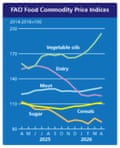
The United Nations' FAO Food Price Index (FFPI) shows that prices of a basket of food commodities rose by 1.6% in April, adding to price rises in February and March.
Prices for vegetable oils, meat and cereals all rose, although sugar and dairy product prices dipped.
Cereal prices rose by 0.8% in April, partly due to drought in parts of the United States of America and expectations of below-average rainfall in Australia.
The UN's Food and Agriculture Organization (FAO) says:
double quotation mark The price increase was further supported by expectations of reduced wheat plantings in 2026, as farmers shift to less fertilizer‑intensive crops amid high fertilizer prices, driven by elevated energy costs and disruptions linked to the effective closure of the Strait of Hormuz.
Vegetable oil prices rose by 5.9% in April, driven by pricier palm, soy, sunflower and rapeseed oils.
The FAO explains:
double quotation mark International palm oil prices rose for the fifth consecutive month in April, largely underpinned by prospective higher demand from the biofuel sector, supported by policy incentives in several producing countries and higher crude oil prices. Additional upward pressure stemmed from concerns over lower production in Southeast Asia in the coming months.
Meat prices rose by 1.2% in April, with bovine meat prices hitting a new peak.
These increases may bolster fears that food prices will rise in the shops for months, and that there may be new shortages in Africa.
However, dairy prices fell by 1.1% in April thanks to lower international quotations for butter and cheese, with abundant milk supplies in the European Union.
And sugar prices plunged by 4.7% in the month.
The FAO says:
double quotation mark The drop in April was mainly driven by expectations of ample global supplies in the current season, reinforced by improved production prospects in key Asian producing countries, notably China and Thailand. The onset of the new harvest in Brazil's key southern growing regions under favourable weather conditions further contributed to the overall decline in international sugar prices.
Key events
Please turn on JavaScript to use this feature
Bond vigilantes are “lurking†despite the small recovery in UK gilt prices this morning, suggests Neil Wilson, investor strategist at Saxo UK:
double quotation mark Election results look very bad for Labour, very good for Reform. We'll see just how much pressure it brings to bear on the prime minister.Gilt markets are steady at the moment but the bulk of counting hasn't even begun. The 10yr gilt yield is holding below 4.9% and the 30yr is also off a few ticks below 5.6%. There's a chance the political scene goes a bit woo-woo and bond markets are very attuned to this. Yields are not doing much this morning but remember we hit 28-year highs on the 30yr earlier this week and the bond vigilantes are lurking.
Political risks associated with a Starmer/Reeves defenestration are bound up with already rising fiscal and inflationary risks for the UK economy.
Sterling was also pretty steady with GBPUSD holding the 1.360 level as it tracks back within the $1.34-36 range of the last month after a couple of stalled attempts to break out in the last two sessions on the improving macro backdrop which has since taken a bit of a turn south.
UK bond yields fall as Starmer pledges to stay on as PM
UK bond prices have now rallied, after Keir Starmer pledged not to resign and analysts suggested Labour was not doing as badly as feared in the council elections.
The yield (or interest rate) on benchmark 10-year bonds has dropped by 2.6 basis points (0.026 of a percentage point) to 4.894% this morning.
Thirty-year bond yields (which hit their highest since 1998 earlier this week) have dropped too, down almost 5bps to 5.562%.
Yields fall when the price of a bond rises.
These moves come as Starmer insisted he will stay on as PM, despite Labour losing hundreds of council seats already today.
He told Sky News:
double quotation mark No, I'm not going to walk away and plunge the country into chaos. We were elected to deal with these challenges and that's what we will do.
Analysts have suggested that if Starmer were replaced by a more left-wing alternative, it could lead to higher borrowing and less commitment to the government's fiscal rules.
Michael Thrasher, Sky News elections analyst, has said that the latest results suggest Labour are in danger of losing more than 1,500 seats, below what he called “the doomsday figure of 2,000 lossesâ€.
The pound, which is vulnerable to political uncertainty, has now gained over half a cent against the US dollar to $1.361.
Global food prices jump for third month running as Iran war drives up costs
Newsflash: Global food prices have risen for the third month running, as the Iran war drives up the price of energy and fertiliser.
The United Nations' FAO Food Price Index (FFPI) shows that prices of a basket of food commodities rose by 1.6% in April, adding to price rises in February and March.
Prices for vegetable oils, meat and cereals all rose, although sugar and dairy product prices dipped.
Cereal prices rose by 0.8% in April, partly due to drought in parts of the United States of America and expectations of below-average rainfall in Australia.
The UN's Food and Agriculture Organization (FAO) says:
double quotation mark The price increase was further supported by expectations of reduced wheat plantings in 2026, as farmers shift to less fertilizer‑intensive crops amid high fertilizer prices, driven by elevated energy costs and disruptions linked to the effective closure of the Strait of Hormuz.
Vegetable oil prices rose by 5.9% in April, driven by pricier palm, soy, sunflower and rapeseed oils.
The FAO explains:
double quotation mark International palm oil prices rose for the fifth consecutive month in April, largely underpinned by prospective higher demand from the biofuel sector, supported by policy incentives in several producing countries and higher crude oil prices. Additional upward pressure stemmed from concerns over lower production in Southeast Asia in the coming months.
Meat prices rose by 1.2% in April, with bovine meat prices hitting a new peak.
These increases may bolster fears that food prices will rise in the shops for months, and that there may be new shortages in Africa.
However, dairy prices fell by 1.1% in April thanks to lower international quotations for butter and cheese, with abundant milk supplies in the European Union.
And sugar prices plunged by 4.7% in the month.
The FAO says:
double quotation mark The drop in April was mainly driven by expectations of ample global supplies in the current season, reinforced by improved production prospects in key Asian producing countries, notably China and Thailand. The onset of the new harvest in Brazil's key southern growing regions under favourable weather conditions further contributed to the overall decline in international sugar prices.
Pound calm despite expectations of bruising defeat for Labour
Sterling has largely shrugged off sweeping Reform UK gains and a bruising set of local election results for Labour, says Antonio Ruggiero, senior FX & macro strategist at Convera.
With the pound up just 0.05% against the euro this morning, and higher against the US dollar, Ruggiero says:
double quotation mark “Sterling has traded relatively calmly into today's open, despite UK local elections expected to deliver a bruising defeat for the Labour government. Polling stations have closed, with Nigel Farage's Reform UK racking up sweeping gains in the first counts. That said, a full picture of the results might not come into focus until later today. We are watching GBP/EUR in particular, as the pair has typically been the clearest expression of sterling's political risk premium.“With the pound widely expected to sell off on the outcome, it is instructive to assess the factors that may temper politically driven bearishness, or at least postpone it. To start, the conflict in the Middle East may have bolstered Starmer's standing marginally, or at least dampened near‑term calls for his removal given the uncertain geopolitical backdrop. In turn, sterling appears to have lost some of its sensitivity to political drama. The Peter Mandelson scandal is a great case in point, sterling showed to be hypersensitive to it earlier in February to grow indifferent as the issue resurfaced on multiple occasions following the outbreak of the conflict.
Pound and UK bonds calm as Starmer refuses to resign
The pound, and UK government bonds, are holding up well despite the governing Labour party having a bad local election.
Sterling has risen by a third of a cent against the US dollar to $1.3585, holding those gains after prime minister Keir Starmer told the media “I'm not going to walk away,†after Labour lost hundreds of council seats, with counting continuing in many places.
UK bond prices have dropped slightly, pushing up the yield (or interest rate) on gilts slightly. That, though, may reflect concerns that the higher oil prices will push up inflation and hurt growth.
Update: The UK's 30-year bond is trading flat at a yield of 5.61%, below the 28-year high (5.778%) hit earlier this week.
Analysts had suggested that the local elections could cause ructions in the markets, if traders concluded that a change of prime minister, and higher government spending, was likely.
FTSE 100 drops at the open
London's stock market is sliding at the start of trading.
The FTSE 100 index has dropped by 67 points, or 0.65%, to 10,209 points.
IAG are among the top fallers, down 5%, after the airline group warned this morning that profits this year will be lower than expected due to the jump on fuel prices.
Intertek Group have dropped by 6.5% after rejecting a takeover approach.
BA’s parent company: supplies of jet fuel could be restricted if Middle East conflict continues
British Airways' parent company has warned its earnings will be lower than expected as the Iran war drives up the cost of jet fuel.
International Airlines Group (IAG) told the City this morning that it expects a “more substantial impact†from the Middle East crisis throughout the rest of the year as the increase in the fuel cost starts to manifest itself.
As a result, IAG expects its profit to be lower than originally anticipated at the beginning of the year.
IAG also cautions that if the current conflict continues to restrict flows of both crude oil and jet fuel from the Middle East, “there is the potential for supplies of jet fuel to be restricted on a global basisâ€.
IAG chief executive Luis Gallego says:
double quotation mark “We are actively managing the uncertainty created by the fuel price increase and its impact, taking the necessary action on yields, costs and capacity. We currently see no issues with fuel availability in our main markets, particularly as we benefit from our investment in fuel self-supply at our hubs.Whilst the impact of the higher fuel price will inevitably lead to lower profit this year than we originally anticipated, we are confident in our business model and strategy, which has made us one of the best-performing airline groups in the world, and which gives us the opportunity to prove our resilience. This confidence means we are on track to continue with the remaining €1 billion return of excess cash.
House prices: rising in the north, weak in the south
Across the UK, house prices are rising faster in the north of the country, and falling parts of the South.
Halifax reports:
-
Northern Ireland still leads UK annual house price growth, with average prices up +7.6% over the past year to £224,851.
-
Scotland also recorded strong growth, rising +4.0% annually to an average price of £222,448.
-
Wales has seen property price growth continue to slow, now +0.7% on annual basis, taking the typical home value to £230,952.
-
The North East of England saw prices rise +4.5% over the year to £183,445, while the North West recorded annual growth of +3.4%, with the average home now costing £248,945.
-
By contrast, the southern markets continue to see prices fall. The South East led declines, with prices down -2.0% year‑on‑year to £383,044, while London saw average values fall by – 1.4% to £536,051.
Charts: UK house prices
UK house prices fell in April
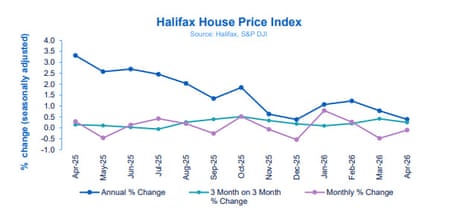
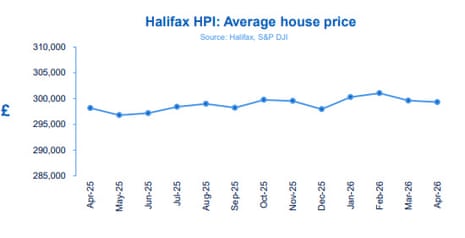
British house prices fell by 0.1% in April as the Iran war hit confidence and drove up borrowing costs.
New data from mortgage lender Halifax that the average house price edged down by 0.1% in April, following a -0.5% fall in March. The average property price has dipped to £299,313, compared with £299,609 a month earlier.
On an annual basis, annual house price inflation slowed to just 0.4%, from 0.8% in the year to March, Halifax's monthly house price index has found.
Amanda Bryden, head of mortgages at Halifax, say:
double quotation mark “After a strong start to the year, recent global developments have added a greater degree of uncertainty to the outlook. In particular, higher energy prices have fed into inflation expectations, prompting markets to reassess the path for interest rates – a shift that has already pushed up borrowing costs for many buyers.“This understandably leads to more caution among some households, with the cost-of-living once again front of mind and extra thought being given to planned property moves.
“Even so, the housing market continues to display the resilience that has been its hallmark in recent years. While activity is likely to cool in the near term, the underlying picture remains one of relative stability, supported by wage growth that continues to outpace house price inflation.
“Another important factor is that the majority of existing homeowners are on fixed-rate mortgages, meaning they are largely insulated from short term changes in interest rates.
Introduction: Oil over $100 a barrel as ceasefire creaks after ‘love tap’
Good morning, and welcome to our rolling coverage of business, the financial markets and the world economy.
Oil is back over $100 a barrel as the US-Iran ceasefire came under strain, undermining hopes of an early reopening of the strait of Hormuz.
Overnight,the US and Iran exchanged fire, with Tehran accusing Washington of violating the ceasefire by targeting two ships at the strait of Hormuz and attacking civilian areas.
The US, though, insisted it struck Iranian targets in retaliation for “unprovoked†attacks on three US warships transiting the strait on Thursday.
Cue a predictable jump in the oil price, two days after hopes of a peace deal breakthrough pushed it down.
This morning, Brent is up 1% at $101 a barrel. That's a fairly modest move, suggesting investors are still hoping that a deal will eventually be reached.
After all, president Donald Trump has described Iran's attack on US destroyers as “just a love tapâ€, and insisted the ceasefire between the two countries is still in effect.
Markets have slipped back thanks to questions about whether the US-Iran ceasefire is holding, reports Jim Reid of Deutsche Bank:
double quotation mark Questions around the ceasefire have already had a market impact in Asia overnight, where all the major equity indices have lost ground. That includes the Nikkei (-0.69%), the KOSPI (-0.73%), Hang Seng (-1.17%), CSI 300 (-0.90%) and the Shanghai Comp (-0.43%).Moreover, European equity futures are down, with those on the FTSE 100 (-0.70%) and the DAX (-0.87%) both lower, although US futures have picked up a bit after yesterday's losses, with S&P 500 futures up +0.21%.
It's going to be a busy day in the markets, with April's US jobs report due at 1.30pm. City traders will also be watching the results of local elections across the UK, where Labour have already lost control of several councils.
The agenda
-
7am BST: Halifax house price index
-
8.30am BST: UN's FAO Food Price Index
-
1.30pm BST: US non-farm payroll report for April
-
3pm BST: University of Michigan survey of US consumer confidence