
UK consumer confidence falls again as consumers get ‘the jitters’
Breaking: UK consumer confidence has fallen for the third month in a row, as people grow more nervous about their personal financial situation and the economy.
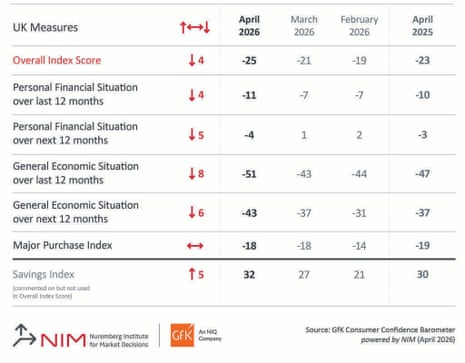
Data provider GfK's Consumer Confidence Barometer, just released, has fallen by four points to -25 in April, the biggest drop in a year.
That's the lowest level since autumn 2023, indicating that the disruption and high energy prices caused by the Iran war is alarming consumers.
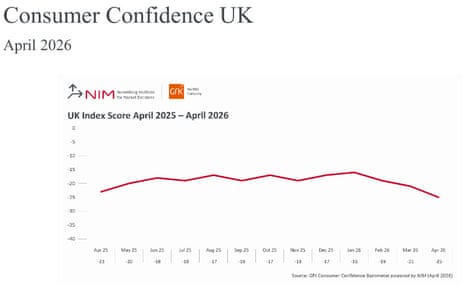
When asked about the UK economy, the measure for the country's general economic situation over the last 12 months decreased by eight points to -51.
Expectations for the general economic situation over the coming 12 months fell by six points to -43, GfK reports.
The survey shows that “consumers really do have the jitters nowâ€, according to Neil Bellamy, consumer insights director at GfK.
Bellamy explains:
double quotation mark The anxiety we saw last month has deepened with a four-point fall in April's consumer confidence headline score to -25. It is a year since we last saw a monthly drop of this size, and we have to go back to October 2023 to find the last time consumer confidence was lower.The biggest declines are in perceptions of the UK economy, with an eight-point slide in views on the economic picture over the last 12 months, and a six-point fall in the forward-looking measure to -43, its lowest level since February 2023.
Consumers were arguably resilient about their personal finances in March, but this month's finance measures, looking back a year (-11) and looking forward (-4), have seen significant slides. Everyone is grappling with rapid price rises, especially at the fuel pumps, which are taking a dent out of household budgets, and people know further price hikes are coming.
The only measure to go up is our savings index, often an indication that people are concerned about what lies ahead, so those who can are building contingency funds.
Consumer confidence is deteriorating sharply, with fuel prices and threats of more energy price increases acting as constant reminders of inflation. While the Gulf crisis is intensifying pressures, much of the current strain reflects earlier domestic cost increases. How long can all this disruption and pain continue?â€
[This survey was due to be published at midnight, but GfK has lifted the embargo after the data was published ahead of schedule earlier today, due to a technical error].
Key events
Please turn on JavaScript to use this feature
Closing post
Time to wrap up, after a day in which evidence mounted of the economic damage caused by conflict in the Middle East.
-
Confidence in the UK economy has fallen sharply amid the mounting economic fallout from the Iran war, surveys show, as businesses prepare to raise their prices and consumers brace for a fresh cost of living shock.
The latest barometer from the data company GfK showed UK consumer confidence slid in April to its lowest level since October 2023, while three separate business surveys revealed a surge in cost pressures facing companies and an expectation they would raise their prices over the coming months.
-
UK service sector firms have reported the biggest rise in cost inflation since 1996 this month
-
British factories have also been hit by rising costs, and a drop in output.
-
The eurozone is suffering too, with private sector output dropping this month
-
There was good news for the government, though – borrowing fell last year, and was a little lower than forecast
-
…however, economists predict the Iran war will push it up again
-
Sainsbury's, WH Smith and Foxtons all flagged that the conflict could hit their businesses.
-
BP's board has suffered a triple climate rebellion in its first shareholder meeting since appointing new leadership to steer the embattled oil company.
Two resolutions, including one to scrap its existing climate reporting, were blocked, while about 18% of shareholders voted against the re-election of BP's chair, Albert Manifold.
FTSE 100 closes in the red
London's stock market has closed lower tonight.
The FTSE 100 index of blue-chip shares has closed 19.5 points lower at 10,457, a 0.19% drop. That's its lowest level in over two weeks.
Precious metals producers were among the fallers, as were Sainsbury's (-3.6%) after it warned that the conflict in the Middle East is squeezing customers' budgets and pushing up its costs.
The key to improving UK consumer confidence could be to resume shipping through the strait of Hormuz, and end the Iran war.
A poll of US oil executives has found they expect domestic production to rise as the ongoing conflict upends global supplies, Reuters reports.
A poll of executives at US energy companies, conducted by the Dallas Federal Reserve, has found that 43% expect US crude production to rise by up to 250,000 barrels per day this year as a result of the Iran war.
About two-thirds of respondents think at least 90% of Gulf production that has been shut in will return to market eventually.
And asked when traffic through the Strait of Hormuz will return to normal levels, 20% said by next month, 39% said August, while the remaining respondents said either by November or later….
This month's drop in UK consumer confidence shows that global tensions are add to consumer doom, warns emeritus professor Joe Nellis, economic adviser at accountancy and advisory firm MHA.
Prof Nellis says this latest reading from GfK delivers “an uncomfortable message†– that UK consumer confidence is sliding as households remain deeply uneasy about the outlook.
He explains:
double quotation mark This is not just a routine wobble. It shows a public that is increasingly cautious about their finances and the wider economy. At these levels, pessimism is firmly in control. Many households are not expecting improvement soon. That mindset is shaping behaviour.Confidence matters because it feeds directly into spending decisions.
Approximately two-thirds of economic activity in the UK is driven by household spending on a wide range of goods and services – food, energy, travel, leisure, and big-ticket items such as cars and furniture. Small shifts in consumer behaviour can therefore have a disproportionate impact on growth. When uncertainty rises, consumers pull back. Major purchases are delayed, discretionary spending is trimmed, and saving becomes a priority. This quickly feeds through to weaker demand, leaving businesses with slower sales and a more challenging trading environment.
The danger is that this becomes self-sustaining, he adds:
double quotation mark A cautious consumer slows the economy, and a weaker economy in turn undermines confidence still further.The message is clear: until both domestic pressures ease and global risks settle, the UK consumer will remain on the defensive – and the economy will struggle to shift out of low gear.
Jeremy Barr
Shareholders of Warner Bros Discovery have voted “overwhelmingly†to approve the company's $110bn merger with Paramount Skydance, the parent company of CBS News, on Thursday.
But shareholders voted against generous proposed compensation packages for WBD executives, including a $550m payout to the outgoing chief executive, David Zaslav.
The boards of both WBD and Paramount have already approved the merger, and shareholders were encouraged to approve it as well.
Zaslav said in a statement:
double quotation mark “Today's stockholder approval is another key milestone toward completing this historic transaction that will deliver exceptional value to our stockholders.We will continue to work with Paramount to complete the remaining steps in this process that will create a leading, next-generation media and entertainment company.â€
M&S chair: Rise in food price inflation is ‘inevitable’

Sarah Butler
Archie Norman​, the chair of Marks & Spencer, has claimed it is “inevitable†that food price inflation will “seep through†by the autumn as farmers, retailers and food makers struggle with rising cost of energy and fuel.
​Even if the Iran conflict stops today​, the veteran retailer said: “it​'s too late for September, it's going to come through.â€â€‹
Speaking at the Retail Technology Show in London, Norman said food prices were unlikely to rise by the 10% talked about by the FDF but ​he predicted that ​a 1-2% uptick​ from the current level “would not be surprising at allâ€â€‹, Food inflation currently stands at 3.7% according to the Office for National Statistics.
“It's obvious cost increases are going to seep through†​Norman said.
H​e said there was “already a bit of a chill†on UK consumers as taxes had gone up and employment was “not that greatâ€. Fuel costs would also begin to weigh on household budgets and “households are going to be a few hundred pounds less well off in the year and are going to be sharper on value and more careful where they spend their money,†he suggested.
Norman said M&S was using AI technology to help plan how it marked down food prices so that it sold as much food as possible to avoid waste. He admitted that the retailer had entered “another world†when it was hit by a cyber attack in Easter 2025 after which it had to close down its website and a number of internal systems.
He also admitted “even now there are traces†of the effects of the attack — for example, staff had to make orders for clothing eight or nine months ago based on “a piece of paper†as systems were not fully operational at the time.
The share of UK consumers expecting price increases in the year ahead has risen to 85% in April, up from 79% in March, today's consumer confidence barometer from GfK shows.
That's the highest since November 2022, Reuters points out.
UK consumer confidence falls again as consumers get ‘the jitters’
Breaking: UK consumer confidence has fallen for the third month in a row, as people grow more nervous about their personal financial situation and the economy.
Data provider GfK's Consumer Confidence Barometer, just released, has fallen by four points to -25 in April, the biggest drop in a year.
That's the lowest level since autumn 2023, indicating that the disruption and high energy prices caused by the Iran war is alarming consumers.
When asked about the UK economy, the measure for the country's general economic situation over the last 12 months decreased by eight points to -51.
Expectations for the general economic situation over the coming 12 months fell by six points to -43, GfK reports.
The survey shows that “consumers really do have the jitters nowâ€, according to Neil Bellamy, consumer insights director at GfK.
Bellamy explains:
double quotation mark The anxiety we saw last month has deepened with a four-point fall in April's consumer confidence headline score to -25. It is a year since we last saw a monthly drop of this size, and we have to go back to October 2023 to find the last time consumer confidence was lower.The biggest declines are in perceptions of the UK economy, with an eight-point slide in views on the economic picture over the last 12 months, and a six-point fall in the forward-looking measure to -43, its lowest level since February 2023.
Consumers were arguably resilient about their personal finances in March, but this month's finance measures, looking back a year (-11) and looking forward (-4), have seen significant slides. Everyone is grappling with rapid price rises, especially at the fuel pumps, which are taking a dent out of household budgets, and people know further price hikes are coming.
The only measure to go up is our savings index, often an indication that people are concerned about what lies ahead, so those who can are building contingency funds.
Consumer confidence is deteriorating sharply, with fuel prices and threats of more energy price increases acting as constant reminders of inflation. While the Gulf crisis is intensifying pressures, much of the current strain reflects earlier domestic cost increases. How long can all this disruption and pain continue?â€
[This survey was due to be published at midnight, but GfK has lifted the embargo after the data was published ahead of schedule earlier today, due to a technical error].
One in five BP shareholders vote against the chair
BP's new chair has received something of a rebuke from shareholders today, amid a row over the energy giant's policies on the climate emergency.
Albert Manifold received 81.8% support from investors at his first BP annual general meeting today, Reuters reports. That's rather short of the level of support which board members usually receive, especially the chair of a FTSE 100-listed company.
This small wave of opposition isn't large enough to dislodge Manifold from his seat at BP, though – though it counts as a significant protest vote.
It follows a recommendation from investor advisor Glass Lewis that BP shareholders should vote against its new chair over his decision to exclude a climate resolution from the AGM.
That resolution asked BP to explain how it would create value for shareholders as oil and gas demand declines.
Shareholders also rejected two other resolutions – a proposal to allow online-only shareholders' meetings, and one (called Resolution 23) to scrap existing climate disclosures. Both fell short of the 75% threshold required to pass.
Mark van Baal, CEO of Follow This, says:
double quotation mark “Defeating resolution 23 signals that shareholders refuse to let BP quietly bury its reporting commitments. The board brought this on itself.â€
Another resolution brought by climate activists, requesting BP to justify its upstream oil and gas spending, got 26% of the votes.
The number of Americans filing new claims for unemployment benefit has risen, but remains low in historic terms.
There were 214,00 new initial claims for jobless support last week, an increase of 6,000 compared with the previous seven days. The previous week's level was revised up by 1,000 from 207,000 to 208,000.
The financial markets are, again, anticipating two increases in UK interest rates this year.
The money markets are indicating that UK bank rate will have increased by 58bps (0.5 of a percentage poin) by the end of this year, meaning two quarter-point rate rises are fully priced in.
Earlier this week the market only expectd around 30bps, meaning one quarter-point rise was priced in, with a small possibility of a second.
American Airlines has warned that the surge in fuel prices from the Iran war will cost it $4bn this year.
The company has cut its earning guidance today – it now expects to make between a 40 cents per share loss and a $1.10 per share profit this financial year. That's down from a previous forecast of a profit of between$1.70 to $2.70 per share.
It told investors:
double quotation mark Based on the forward fuel curve and the current revenue outlook, the midpoint of the company's full-year earnings guidance is approximately flat to 2025, despite a more than $4 billion increase in expense related to higher prices for jet fuel.
UK manufacturing output and confidence slumps and costs jump
Sentiment among UK manufacturers has deteriorated sharply, new data from the CBI shows.
The CBI's industrial trends reports shows that optimism among factory bosses about both the business situation and export prospects have fallen at their fastest rates since the onset of the COVID-19 pandemic.
Its latest Industrial Trends report shows that output and orders both declined in the last quarter, as competitiveness in UK markets deteriorated at a record pace.
The CBI reports:
double quotation mark Manufacturing output fell in the three months to April, and at a faster pace than in the three months to March. The decline was broad-based, but driven by the food, drink & tobacco, chemicals, metal products and mechanical engineering sub-sectors.
Worryingly, manufacturers expect the decline in new orders to accelerate, with expectations for the next three months close to the weakest since April 2020 (when the global economy was locked down due to the Covid-19 pandemic).
The CBI also reports that cost pressures remain elevated – confirming the message from this morning's PMI report.
They say:
double quotation mark Growth in average costs per unit of output accelerated in the three months to April, compared with January, and unit costs are expected to rise at the fastest pace for over three years in the coming quarter.
Reeves launches investment push at London stock exchnage
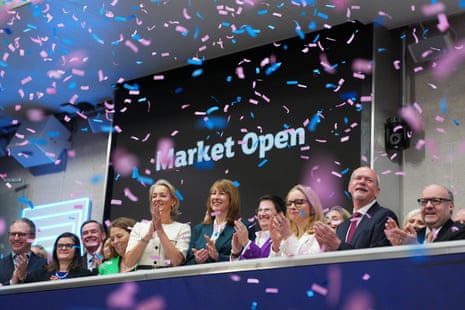
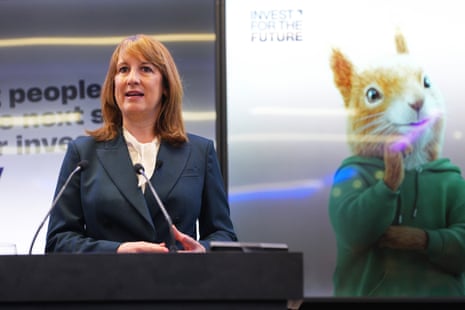
Today's drop in share prices on the London stock market is a less-than-auspicious start to the UK government's push to encourage people to invest.
Rachel Reeves launched the retail investment campaign, which will cost up to £50m, by attending the opening of trading at the London stock market. But as lunchtime approaches the market is still down around 1%.
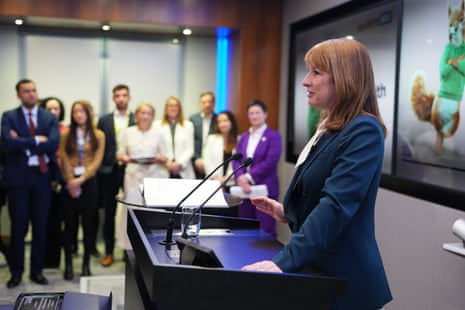
The campaign involves a finance “savvy†CGI squirrel to encourage cautious British savers to shift out of cash and start investing.
The aim is to create an industry-wide effort to improve confidence and understanding of investing across the UK.
The choice of a red squirrel to front the chancellor's investment push seems slightly odd, as they are endangered (yes, and so are the red squirrels….).
FTSE 100 at two-week low
The London stock market has fallen further into the red after this morning's PMI report showed UK firms were being hit by sharp cost rises.
The FTSE 100 is now down 107 points, or 1%, at 10,369, its lowest in just over two weeks.
Derren Nathan, head of equity research at Hargreaves Lansdown, says the PMi survey knocked shares lower:
double quotation mark The S&P Flash UK PMI for April showed an upturn in both services activity, which reached a two-month high of 52.0, and manufacturing, which was the strongest print in 47 months at 53.6. But there's a major caveat.Much of this increased momentum comes from a dash to lock in purchases, on fears of price rises and supply chain disruption from the war. An underlying decline in business confidence and a weak outlook for the labour market tallies with our view that Bank of England lending rates are likely to hold steady until firm progress towards the end of the Iran war is made. The FTSE 100 is down circa 50 points further following the release.
Asos moving some production to UK to avoid supply chain disruption
Sarah Butler
​Asos is shifting more production closer to home – to Turkey, Morocco and even the UK – as it tries to offset disruption to shipping caused by the Middle East conflict.
José Antonio Ramos Calamonte​, the chief executive of the online fashion retailer, said the group had seen an increase in freight costs and longer delivery times as a result of the conflict which has pushed up fuel prices but he said:
double quotation mark “We are navigating the cost impact through flexibility of different [manufacturing] origins and shipping methods.â€
He said the group had already been moving some production from the Far East before the conflict began but that had stepped up so that now about a third of its clothing was made closer to home including Turkey, Morocco and the UK.
“We were ahead of the curve,†he said.
Calamonte said that so far there had not been inflation on costs but if the conflict continued then the price of Polyester was likely to rise but prices of other fabrics such as cotton were coming down. He said there were so many factors at play that the outlook on price was currently “a bit vagueâ€.
​Asos said on Thursday that sales fell 9% to £1.17bn in the half year to 1 March but pre-tax losses narrowed to £138m from £241.5m a year before as it shifted away from heavy discounting. Shares in Asos rose 1.3% in morning trading as the company said it attracted 9% more new customers in March, the first month of growth since September 2021.
Asos also said it was pursuing a £7m refund of US tariffs after courts ruled the levies should not have been imposed.
The surge in cost pressures hitting UK companies adds to the dilemma facing the Bank of England, which is due to announce its next decision on interest rates in a week's time.
Chris Williamson, chief business economist at S&P Global Market Intelligence says:
double quotation mark The UK economy has gathered some renewed momentum in April after the initial impact of the war in the Middle East caused growth to stall in March, but the upturn comes with a catch. The improved rate of expansion is in part a reflection of a short-term boost from a rush to secure purchases ahead of feared price rises and supply shortages linked to the war.Prices have spiked higher at a rate not previously seen by the survey outside of the pandemic, suggesting inflation could rise more than many forecasters have been anticipating. Prices are rising not just because of surging energy costs, but also due to increases in charges levied for a wide variety of goods and services, with price hikes often stoked by supply concerns. The number of supply delays reported has jumped to the highest on record if the pandemic is excluded.
Business confidence and employment have also been dragged lower by the ongoing conflict, boding ill for growth to weaken in the coming months just as price pressures intensify.
The survey highlights the difficult choices facing policymakers at the Bank of England. The spike in price pressures will add to calls for rate hikes to dampen inflation, but the Bank will need to carefully assess the degree to which economic growth might weaken. While April's PMI is indicative of the economy rebounding from a flat picture in March to a 0.2% quarterly growth rate, the details of the survey hint strongly that this pace cannot be sustained should the crisis persist.â€
Biggest jump in UK service sector cost inflation since at least 1996
Ouch! UK services sector companies have been hit with the biggest jump in cost inflation in at least 30 years, as the Iran war drove up petrol and diesel prices.
A survey of purchasing managers at British firms has shown that service providers experienced a surge in cost pressures, this month, largely due to higher fuel prices.
The acceleration in service sector cost inflation since March was the greatest for a single month since the data began being tracked in July 1996.
This follows yesterday's inflation report, which showed that fuel prices pushed up costs in March.
Data provider S&P Global also found that overal input cost inflation this month has hit the highest level since November 2022, driven by a rapid increase in raw material prices in the manufacturing sector.
The report says:
double quotation mark Manufacturing production returned to growth in April, following a marginal decline in the previous month. A number of firms suggested that customers had brought forward orders and sought to build safety stocks in the expectation of rising prices and supply constraints.That said, there were also some reports that raw material shortages and international shipping disruptions had weighed on production volumes in April.
Overall, the flash UK PMI composite output index rose to 52.0 in April, up from 50.3 in Mach (where 50 points shows stagnation).
However, it also found that business optimism at UK private sector firms fell to its lowest since last April, when Donald Trump's trade war hit confidence.